On this page
- 1. Rewards come from two layers
- 2. Consensus layer rewards: an attendance score
- The three votes are not equally hard
- Being late costs you too
- 3. Execution layer rewards: don't miss your turn
- MEV and relays
- 4. So what makes APY differ
- What you can't control (= says nothing about the operator)
- What you can control (= where operators separate themselves)
- 5. Slashing: losing principal
- 6. What FP Validated does
- We push down P2P latency and peer quality
- We maintain client diversity
- We run strategies to maximize MEV extraction
- We remove single points of failure with DVT
- A three-gate slashing prevention pipeline
- We ban automatic failover
- The system notices problems before people do
- We don't keep our infrastructure in one basket
- 7. Closing
Stake ETH, earn rewards. Everyone knows that part. But ask where exactly the money comes from, or why the same 32 ETH earns 3.1% APY with one operator and 2.6% with another, and few people can give you a precise answer.
By the end of this post, you'll be able to:
- Break staking rewards down into their components
- Read an operator's APY and tell how much of it reflects actual operational skill
- Know what to ask when choosing a validator operator
1. Rewards come from two layers
A validator's income splits into two streams with completely different origins.
Consensus layer rewards are newly issued ETH, in other words, inflation. Do the work the network assigns you, and the protocol pays you out of new issuance. Think of it as a salary: it arrives every epoch (about 6.4 minutes), steadily and predictably.
Execution layer rewards come from fees that users pay. When your turn comes to propose a block, you collect the priority fees from every transaction in it, plus MEV income. Think of it as a bonus: your turn doesn't come often, but when it does, the amount is large.

The execution layer share swings hard with market conditions. When the network is quiet it can be close to nothing; on a day with a major market event, a lucky proposer can earn several months' worth of income in a single block.
2. Consensus layer rewards: an attendance score
Consensus layer rewards pay for five jobs. The weight of each is a constant baked into the protocol, dividing a denominator of 64.
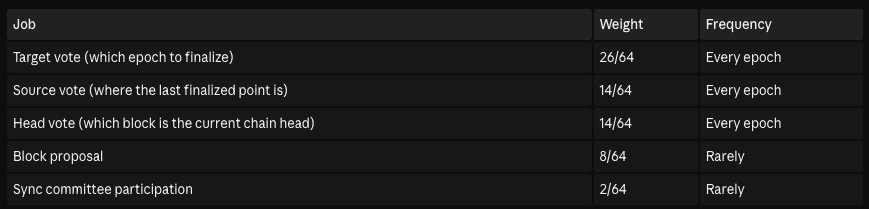
The first three (attestations) add up to 54/64, about 84%. Most of your consensus layer income comes down to one question: did you cast a vote every 6.4 minutes, on time, correctly? Not sophisticated technology. A plain attendance score. Which is why the essence of validator operations is high availability.
The three votes are not equally hard
Source and target votes are relatively easy. They point at an already-finalized past, so a healthy node almost never gets them wrong. But miss one or get one wrong and you take a penalty. Not just forgone income. Your staked principal shrinks.
The head vote is different. You have to point at the block produced in the immediately preceding slot, and if that block hasn't reached your node yet, you can't get it right. A slot is 12 seconds, and the attestation deadline is 4 seconds in. If the block doesn't propagate to your node within 4 seconds, you simply miss the head vote.
This makes the head vote the clearest window into operational skill. Getting it wrong carries no penalty, but the 14/64 reward vanishes. A hundred or two hundred milliseconds of latency, accumulated over a year, is what separates operators' annual returns.
Being late costs you too
Even a correct vote earns less if it doesn't make it into the very next block. Right answer, submitted late. This is why network quality, peer composition, and node placement all feed directly into revenue.
3. Execution layer rewards: don't miss your turn
Block proposal duty is assigned at random. With roughly a million active validators and 7,200 slots per day, a single validator gets its turn about once every four months. Not a lottery, but not frequent either.
And that one turn is big. The proposer collects the priority fees from every transaction in the block, plus MEV on top.
MEV and relays
MEV is the extra value created by how transactions are ordered within a block. Participants chasing arbitrage or liquidations pay to have their transactions placed exactly where they want them.
Extracting this yourself takes serious block-building infrastructure, and realistically, individual validators can't each build a competitive one. So in practice most validators use MEV-Boost: professional builders submit blocks through relays, and the proposer picks the highest bid. Outsourced MEV extraction, essentially.
4. So what makes APY differ
Let's split everything so far into what you can control and what you can't.
What you can't control (= says nothing about the operator)
First, total staked ETH. Ethereum's new issuance grows with the square root of the total staked amount. Quadruple the stake, and issuance only doubles. Four times as many people splitting a pie that only got twice as big. As more ETH gets staked, per-validator yield falls. If APY is lower than last year, it's most likely not your operator slipping; it's the steadily growing amount of staked ETH.
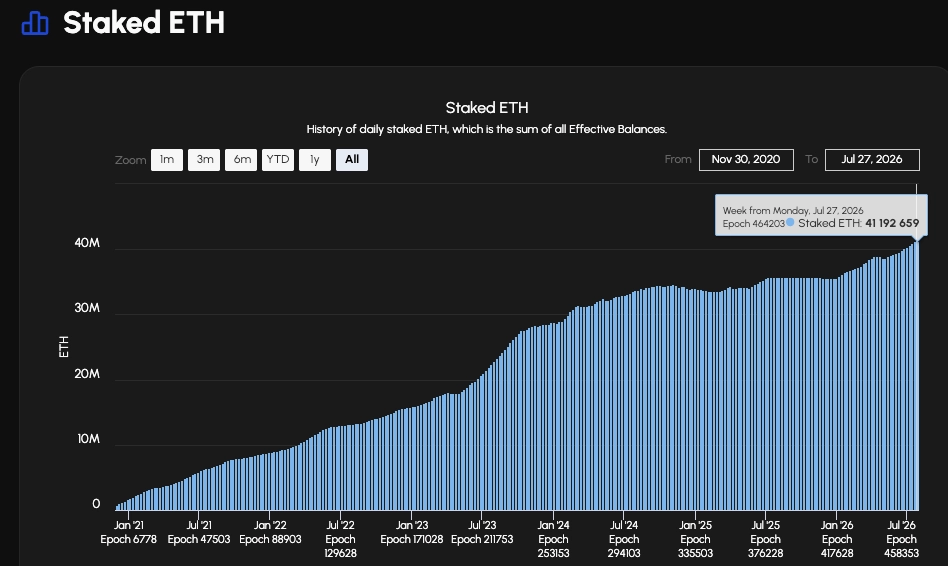
Source: beaconcha.in
Second, network activity. When usage is high, gas is expensive and MEV opportunities are plentiful, execution layer rewards grow. When it's quiet, blocks have spare capacity, nobody needs to bid up priority fees, and MEV opportunities thin out. That's a market cycle, not operator skill.
What you can control (= where operators separate themselves)
- Uptime and attestation success rate. A node that's down doesn't just miss rewards; its balance shrinks. Ethereum's design is symmetric: the reward for participating and the penalty for missing are about the same size. A single day of downtime can wipe out several days of income.
- Attestation timing. The head vote and inclusion delay problem from earlier. How fast blocks reach you, and how fast your votes spread. Hardware, network paths, and node tuning all show up here.
- MEV relay configuration. How much you extract when your proposal turn comes. Relay count, relay health checks, and fallback design for building your own block when relays fail.
- Not getting slashed. Critical enough to deserve its own section, next.
5. Slashing: losing principal
Slashing happens when a validator produces two contradictory signatures. Whether it was malice or a mistake doesn't matter. If the signature records conflict, you're slashed, no appeals.
Here's what follows:
- An immediate initial penalty
- Forced exit begins, locking your funds for about 36 days
- Your balance keeps draining throughout
- And if many other validators were slashed around the same time, the correlation penalty can take most of your balance
The scary part is that this usually comes from a mundane operational mistake, not a sophisticated hack. Squeezing out an extra 0.1% APY matters far less than keeping your slashing probability at zero. The former is a few percent of annual income. The latter is a large loss of principal.
6. What FP Validated does
Here's what these principles look like in our actual operations.
We push down P2P latency and peer quality
The head vote only works if the block reaches you within 4 seconds, and server specs alone won't get you there. Ethereum's P2P network has a reputation system of sorts: how other nodes rate you as a peer determines how fast data reaches you. We continuously test peer composition, geographic placement, dedicated bare metal, and alternative propagation paths (e.g. Optimum).
We maintain client diversity
We don't run the whole fleet on one client combination. We test and package multiple execution/consensus client pairings, so a bug in any single client can't take down every node at once.
We run strategies to maximize MEV extraction
A proposal turn comes about once every four months, and that one turn is nearly all of the execution layer income. We curate our relay list and rotate out problem relays, and we don't depend on MEV-Boost alone: local block-building fallback secures at least the priority fees.
We remove single points of failure with DVT
Our mainnet validators run on SSV-based distributed validation (DVT). Each key is split across multiple operator nodes, so attestations keep flowing even if a node dies, and no single place holds the whole key, which structurally lowers the risk of key-leak slashing.
A three-gate slashing prevention pipeline
The slashing condition, the same key signing in two places at once, can arise from operator error at any time. We've built the defenses into a staged pipeline so that the system catches mistakes instead of relying on people. The more keys you operate, the more that structure pays off.
We ban automatic failover
Automatic failover for signing workloads is blocked at the deployment manifest level. Node migrations follow a fixed order: fully stop the old signer (hard stop), cut off key access (secret gate), and only bring up the new signer after confirming the old one is gone. Slow, but the principle matters more: a signing gap is acceptable, a double sign is not.
The system notices problems before people do
We collect metrics from every node and monitor the indicators that drive validator performance: attestation success rate, proposal results, peer count, sync status. When something looks off, alerts reach the on-call engineer, and an AI agent starts analyzing the situation first.
We don't keep our infrastructure in one basket
Nodes are spread across multiple datacenter providers, so one provider's outage can't drag down fleet-wide uptime. Signing keys live only in a dedicated secret store, and deployments only go live with explicit human approval.
7. Closing
- Most of the reward comes from diligence, not flash. Correct, on-time voting is 84% of consensus layer rewards. A vote every 6.4 minutes, done right. Simple, but it's the single biggest factor in your APY.
- When you look at an APY number, separate the causes. Total stake and market activity are outside anyone's control. An operator's skill shows in uptime, attestation timing, and similar operational craft.
- Principal over yield. Slashing can erase years of rewards at once and cut into principal. When choosing an operator, questions like "what's your slashing prevention strategy" and "how do you manage keys" matter more than "what's your APY."